
What Are AI Solutions? A Complete Guide for Businesses in 2026
August 18, 2026
AI Solutions for Business: How Artificial Intelligence Automates Processes, Improves Decision-Making and Reduces Operational Risk
Artificial intelligence (AI) is no longer limited to research laboratories or technology companies. Businesses across logistics, transportation, construction, facilities management, security, manufacturing, healthcare and other industries are using AI solutions to automate repetitive work, analyse large volumes of data, identify risks and make faster operational decisions.
But what exactly is an AI solution?
An AI solution is more than simply installing an AI model or using a chatbot. In a business environment, an AI solution combines artificial intelligence with data, software, sensors, cameras, hardware and business workflows to solve a specific operational problem.
For example, an AI solution can analyse video footage to identify whether workers are wearing the required personal protective equipment (PPE), automatically calculate the dimensions of parcels, identify potentially dangerous driving behaviour or detect unusual activity around a facility.
The objective is not to replace people.
The objective is to help people see more, process information faster, automate repetitive tasks and make better decisions.
For businesses considering digital transformation in 2026, understanding how AI solutions work — and where they can create measurable value — is an important first step.
What Are AI Solutions?
AI solutions are technology systems that use artificial intelligence to analyse information, recognise patterns, automate tasks, generate insights or support business decisions.
Unlike traditional software, which generally follows predefined rules, AI systems can use techniques such as machine learning, computer vision, natural language processing and predictive analytics to interpret data and respond to changing situations.
A typical business AI solution may combine:
• Artificial intelligence and machine learning models
• Computer vision
• Cameras and video feeds
• IoT sensors
• GPS and telematics data
• Cloud computing
• Edge computing
• Business applications
• Dashboards and analytics
• Automated alerts and workflows
• APIs and enterprise system integrations
This means AI can operate as part of a wider business ecosystem rather than as a standalone technology.
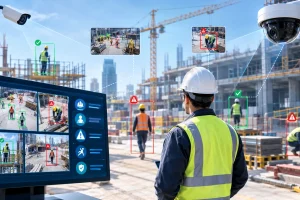
For example, a construction company could connect existing CCTV cameras to an AI video analytics platform. Instead of relying entirely on employees to watch screens, the AI system can analyse video streams and identify predefined safety events.
When a potential PPE violation is detected, the system can trigger an alert so that a supervisor can investigate and respond.
This is where AI becomes particularly valuable for business: turning raw data into actionable information.
How Do AI Solutions Work?
Although AI systems can be technically sophisticated, the business process can be understood through a simple cycle:
Data → AI Analysis → Detection or Prediction → Insight → Action
1. Data Collection
AI needs data to analyse.
Depending on the application, data may come from:
• CCTV cameras
• Mobile cameras
• Vehicle dashcams
• GPS trackers
• IoT sensors
• Images
• Documents
• Transaction systems
• Enterprise software
• Customer interactions
• Equipment sensors
The quality and relevance of this data are important because AI cannot reliably produce useful insights from poor or incomplete information.
2. AI Analysis
The AI model processes the incoming information.
For example, computer vision can analyse images or video to identify objects, people, behaviours or events.
A logistics AI system may analyse an image of a package and identify its dimensions.
A workplace safety system may analyse a video stream and determine whether a worker is wearing a helmet or safety vest.
A fleet AI system may analyse vehicle and driving information to identify potentially risky behaviour.
3. Detection, Classification or Prediction
The AI system then produces an output.
This could include:
• Object detected
• PPE violation detected
• Vehicle approaching an area
• Driver risk identified
• Package dimensions calculated
• Equipment anomaly detected
• Unusual activity identified
• Potential incident detected
More advanced systems can also predict likely outcomes based on historical patterns.
4. Business Insight
The information becomes useful when it is presented in a way that employees and managers can understand.
This may involve:
• Dashboards
• Reports
• Notifications
• Risk scores
• KPIs
• Analytics
• Automated workflows
5. Action
The final step is turning intelligence into action.
For example:
AI detects PPE violation → supervisor receives alert → supervisor investigates → corrective action is taken → incident is recorded for future analysis.
This closed-loop approach is what makes an AI solution useful to an organisation.
What Are the Main Types of AI Solutions for Businesses?
AI can be applied to almost every industry, but several categories are particularly relevant to business operations.
1. AI Computer Vision and Video Analytics
AI video analytics uses artificial intelligence and computer vision to analyse images and video automatically.
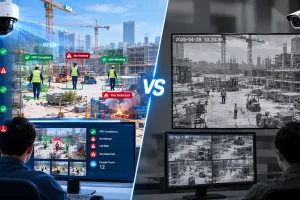
Traditional CCTV primarily records what happened.
AI-enabled video analytics can help identify what is happening.
Depending on the application, AI vision systems can detect:
• People
• Vehicles
• Objects
• PPE compliance
• Falls
• Smoke
• Fire
• Crowd activity
• Restricted-area access
• Illegal parking
• Abandoned objects
• Other predefined events
This can significantly improve the usefulness of existing surveillance infrastructure.
Instead of requiring employees to continuously watch multiple screens, AI can analyse video streams and highlight events requiring attention.
V3 Smart Technologies has applied AI video analytics to areas including workplace safety, security, monitoring and operational intelligence. Its earlier work on AI-powered PPE detection demonstrates how computer vision can be integrated with video surveillance to identify safety violations and generate real-time alerts.
Example: Construction Safety
Consider a construction site with multiple cameras.
A conventional CCTV system records the site.
An AI-powered system can analyse the footage and identify situations such as:
Worker enters restricted zone → AI detects event → alert generated → supervisor responds.
This changes surveillance from a primarily reactive recording system into a more proactive monitoring capability.
2. AI Dimensioning Solutions
AI dimensioning is particularly useful for logistics, warehousing, transportation and fulfilment operations.
Traditional dimension measurement can involve manual measurement using rulers, tapes or specialised equipment.
An AI dimensioning solution can use computer vision to automate the process.
The system may capture an image of an item or shipment and use AI to estimate or calculate its dimensions.
This can help businesses:
• Reduce manual measurement
• Speed up shipment processing
• Improve data accuracy
• Optimise vehicle utilisation
• Improve warehouse operations
• Support better packing decisions
• Reduce operational manpower requirements
For logistics companies processing large numbers of shipments, even small improvements in processing time can produce significant operational benefits.
V3’s AI Solutions portfolio includes AI Dimensioning designed for logistics, warehousing and transportation applications.
3. AI for Workplace Safety
Workplace safety is another important application of artificial intelligence.
Businesses operating construction sites, industrial facilities, warehouses and other high-risk environments often need to monitor compliance continuously.
AI can assist by detecting safety-related events through cameras and other data sources.
Examples include:
• PPE detection
• Helmet detection
• Safety vest detection
• Fall detection
• Restricted-area detection
• Unsafe behaviour detection
• Vehicle-person proximity monitoring
• Hazard detection
The advantage is not simply automation. It is continuous visibility.
Human supervisors cannot realistically watch every location at every second. AI can provide another layer of monitoring and help direct human attention towards situations that may require investigation. However, AI should be treated as a decision-support and monitoring tool rather than an unquestionable source of truth. Businesses should establish appropriate escalation, verification and response procedures.
4. AI for Fleet and Driving Risk Management
Transportation companies generate enormous amounts of operational data.
Vehicles can produce information about:
• Location
• Speed
• Acceleration
• Braking
• Cornering
• Driving patterns
• Road conditions
• Vehicle status
• Camera footage
AI can analyse these different sources of information to identify patterns that may indicate elevated driving risk.
An AI driving risk management system may generate:
• Driver risk scores
• Behavioural insights
• Safety alerts
• Risk trends
• Driver comparisons
• Event classifications
This enables fleet managers to move beyond simply asking:
“Where is my vehicle?”
and towards:
“How safely is my fleet operating?”
V3 has developed AI driving risk management capabilities for applications including autonomous and electric vehicle environments, building on its broader fleet-management and mobility technology experience.
5. Predictive AI and Business Analytics
One of the most valuable applications of AI is finding patterns within large datasets.
Traditional reporting tells businesses what happened.
AI-powered analytics can help businesses understand:
• Why something happened
• What patterns are emerging
• What may happen next
• Where operational risks are increasing
• Where resources may be better allocated
For example, a fleet operator could analyse historical vehicle information to identify patterns associated with maintenance requirements.
A facilities management company could analyse work orders to identify recurring issues.
A logistics operator could analyse delivery data to identify inefficient routes or recurring operational bottlenecks.
The objective is to move from reactive management to proactive decision-making.
6. AI Automation
AI can also automate repetitive processes that previously required significant human involvement.
Examples include:
• Image classification
• Document processing
• Data extraction
• Incident identification
• Report generation
• Alert generation
• Customer enquiry handling
• Workflow routing
• Data validation
The most effective implementations generally do not attempt to automate everything.
Instead, businesses identify repetitive, measurable and rules-driven processes where AI can create a clear operational advantage.
AI Solutions vs Traditional Software: What Is the Difference?
Traditional software typically follows predefined instructions.
For example:
If vehicle speed exceeds X km/h → generate an alert.
An AI system may analyse a broader combination of information and recognise patterns that are more difficult to define using simple rules.
For example:
Analyse driving behaviour, vehicle movement, environmental information and historical patterns → calculate a risk level.
This distinction is important.
Traditional automation remains extremely useful.
In many real-world business applications, the best solution is actually a combination of:
Traditional software + AI + IoT + human expertise.
AI should therefore not be viewed as a replacement for conventional technology.
It is another layer of intelligence that can enhance an existing digital ecosystem.
What Are the Benefits of AI Solutions for Businesses?
1. Automate Repetitive Tasks
AI can take over certain repetitive monitoring, classification and analysis tasks.
Employees can then spend more time on activities requiring judgement, communication and problem-solving.
2. Improve Operational Visibility
AI can process information continuously and provide businesses with a clearer picture of what is happening across their operations.
3. Reduce Human Error
Automating repetitive processes can reduce errors caused by fatigue, inconsistent manual processes, or missed observations.
AI does not eliminate errors completely, however. Models must be properly trained, tested, and monitored.
4. Improve Response Times
AI-powered alerts can identify specific events and bring them to an employee’s attention quickly.
This is particularly valuable for:
• Safety incidents
• Security events
• Operational exceptions
• Fleet risks
• Equipment anomalies
5. Generate Actionable Insights
AI can turn large volumes of raw data into patterns, scores and insights that managers can use for decision-making.
6. Improve Productivity
When routine processes become faster and more automated, employees can focus on higher-value activities.
7. Support Better Resource Allocation
AI insights can help managers determine where manpower, vehicles, equipment and other resources should be allocated.
8. Scale Operations
AI can help businesses process more information without necessarily increasing manpower at the same rate.
This is particularly important as businesses face labour constraints and increasing operational complexity.
What Industries Use AI Solutions?
AI solutions are increasingly applicable across many industries.
Logistics and Transportation
Applications include:
• AI dimensioning
• Fleet analytics
• Driving risk management
• Route intelligence
• Video analytics
• Vehicle monitoring
Construction
Applications include:
• PPE detection
• Safety monitoring
• Fall detection
• Site surveillance
• Restricted-area monitoring
Facilities Management
Applications include:
• Security monitoring
• Incident detection
• Asset monitoring
• Workforce optimisation
• Automated inspections
Municipal and Environmental Services
AI can support:
• Illegal dumping detection
• Waste monitoring
• Vehicle monitoring
• Environmental surveillance
• Smart-city applications
Security
AI video analytics can assist with:
• Intrusion detection
• Crowd monitoring
• Object detection
• Restricted-area monitoring
• Incident identification
Warehousing and Manufacturing
AI can support:
• Quality inspection
• Object recognition
• Dimension measurement
• Process monitoring
• Predictive maintenance
The important question is therefore not simply:
“Can my business use AI?”
For most organisations, the better question is:
“Which business problem would benefit most from AI?”
How to Choose the Right AI Solution for Your Business
Implementing AI should begin with the business problem, not the technology.
Step 1: Identify the Operational Problem
Start by asking:
• What process consumes significant manpower?
• Where are errors occurring?
• What information is difficult to collect?
• What risks are difficult to monitor?
• Where are response times too slow?
• What decisions are currently based on incomplete information?
Step 2: Determine Whether AI Is Appropriate
Not every problem requires AI.
A simple workflow automation may be more appropriate if the process follows clear rules.
AI becomes more useful when the problem involves:
• Image or video interpretation
• Pattern recognition
• Large datasets
• Prediction
• Classification
• Complex decision support
Step 3: Assess Your Data
Ask:
• What data is available?
• Is it accurate?
• Is there enough historical information?
• Can cameras or sensors collect the required information?
• Can existing systems be integrated?
Data readiness is often more important than choosing the most sophisticated AI model.
Step 4: Start With a Measurable Use Case
A strong AI pilot should have clear KPIs.
For example:
Before AI: Manual inspection requires 10 staff-hours per day.
After AI: AI automates first-level detection and reduces manual inspection to 4 staff-hours.
Potential improvement:
60% reduction in manual inspection time.
The exact result will vary by application, but the principle is important: AI projects should be measured against business outcomes.
Step 5: Integrate AI Into Existing Workflows
AI should not create another disconnected dashboard that employees rarely use.
The strongest implementations connect AI outputs to existing:
• Workforce systems
• Fleet management systems
• ERP platforms
• Mobile applications
• Dashboards
• Notification systems
• Reporting workflows
This is where integration capability becomes critical.
What Are the Risks and Challenges of AI Implementation?
AI can create significant value, but businesses should also understand its limitations.
Data Quality
Poor-quality data can result in unreliable AI outputs.
False Positives and False Negatives
An AI system may occasionally identify an event incorrectly or fail to detect an event.
Critical applications should therefore include appropriate verification and escalation processes.
Privacy and Security
Businesses should carefully consider:
• Personal data
• Video footage
• Employee information
• Access controls
• Data retention
• Cybersecurity
• Regulatory requirements
Model Performance
AI models can perform differently across environments.
Lighting, camera positioning, weather, objects, people and operating conditions can all affect performance in computer vision applications.
Change Management
Employees need to understand how AI affects their workflows.
Successful implementation requires people, processes and technology to work together.
Responsible AI: Why Trust Matters
AI adoption should not be based solely on accuracy or return on investment.
Businesses should also consider whether an AI system is:
• Reliable
• Secure
• Explainable
• Transparent
• Fair
• Privacy-conscious
• Resilient
• Accountable
The U.S. National Institute of Standards and Technology (NIST) AI Risk Management Framework provides a widely referenced framework for helping organisations manage AI risks and incorporate trustworthiness considerations throughout the AI lifecycle.
For businesses deploying AI, this means considering risk before deployment, during implementation and throughout ongoing operation.
Responsible AI is particularly important when technology influences safety, employment, security or other consequential decisions.
AI Solutions Should Augment People — Not Simply Replace Them
One of the biggest misconceptions about AI is that successful AI implementation means eliminating humans from the process.
In many operational environments, the better approach is:
AI detects → Human verifies → Business acts.
For example, an AI system may detect a potential safety violation.
Rather than automatically taking punitive action, the system can alert a supervisor who reviews the event and decides what action is appropriate.
This creates a practical balance between automation and human judgement.
AI handles the scale.
People provide the context.
Why Businesses Should Think Beyond “AI”
Buying an AI model does not automatically create an AI transformation.
A successful AI solution requires an ecosystem.
That ecosystem may include:
Cameras → Connectivity → AI Engine → Data Platform → Dashboard → Alert → Human Response → Business Analytics
Every component matters.
A highly accurate AI model is of limited value if the camera cannot capture usable footage.
A good detection system is less useful if alerts do not reach the right employee.
A powerful dashboard provides limited value if the data cannot be integrated into existing workflows.
This is why businesses should evaluate end-to-end AI solutions, rather than looking only at the AI model itself.
How V3 Smart Technologies Helps Businesses Adopt AI
V3 Smart Technologies develops AI and automation solutions designed around real-world operational challenges.
Its AI capabilities include applications across AI dimensioning, computer vision, video analytics, construction safety and AI driving risk management.
V3’s broader technology platform also combines AI with fleet management, workforce management, IoT and mobility technologies.
This enables AI to be connected to operational systems rather than operating in isolation.
V3 has developed technology solutions for businesses across industries including:
• Construction
• Logistics
• Transportation
• Facilities management
• Municipal services
• Emergency services
• Healthcare
• Regulatory enforcement
The company’s technology journey has also included AI, IoT, fleet and workforce optimisation, with V3Nity serving as its software platform for integrating solution modules and business systems.
For businesses exploring AI, this broader systems experience can be important because successful implementation often involves more than deploying an AI algorithm.
It involves understanding the operational environment, data, hardware, software, people and workflow around the AI.
What Is the Future of AI Solutions for Businesses?
The next stage of AI adoption is likely to move beyond individual AI applications towards connected intelligent systems.
Instead of:
One camera → one AI model → one alert
Businesses can increasingly move towards:
Multiple data sources → AI analysis → integrated intelligence → automated workflows → predictive decision-making
For example, a future logistics operation could combine:
• Vehicle GPS
• Driver behaviour
• AI dashcams
• Shipment information
• Warehouse data
• AI dimensioning
• Traffic information
• Workforce availability
The result is a more complete operational picture.
AI therefore becomes one part of a wider intelligent business ecosystem.
The organisations that benefit most may not necessarily be those using the most AI.
They may be the organisations that identify the right problems, deploy AI responsibly and successfully connect AI insights to business action.
Frequently Asked Questions About AI Solutions
What is an AI solution?
An AI solution is a technology system that uses artificial intelligence to analyse data, recognise patterns, automate processes, generate insights or support business decisions.
What are examples of AI solutions?
Examples include AI video analytics, AI dimensioning, PPE detection, facial recognition, predictive maintenance, driving risk management, intelligent document processing and predictive analytics.
How can AI help businesses?
AI can help businesses automate repetitive tasks, improve operational visibility, analyse large datasets, identify risks, reduce manual work, improve response times and support better decision-making.
Is AI suitable for small businesses?
Yes. AI does not have to begin with a large enterprise-wide transformation. Smaller businesses can start with a specific, measurable use case and expand after demonstrating value.
Does AI replace employees?
Not necessarily. In many applications, AI is most effective when it augments employees by automating repetitive tasks and directing human attention towards situations requiring judgement.
How much does an AI solution cost?
AI solution costs vary significantly depending on the application, number of users, cameras or devices, AI processing requirements, integrations, software and deployment model. Businesses should evaluate total cost against measurable operational benefits rather than comparing software prices alone.
What is AI computer vision?
AI computer vision is a branch of artificial intelligence that enables computers to interpret information from images and video. Businesses can use computer vision for applications such as PPE detection, object recognition, safety monitoring and automated inspection.
What is the difference between AI and automation?
Automation generally follows predefined rules to execute tasks. AI can analyse data, recognise patterns and make predictions or classifications. The two technologies can be combined to create intelligent automation.
How should a company start an AI project?
Start with a specific business problem, identify the data required, establish measurable KPIs, select a suitable AI use case and conduct a controlled pilot before scaling.
Final Thoughts: AI Is a Business Tool, Not Just a Technology
The question businesses should be asking in 2026 is no longer simply:
“Should we use AI?”
The more useful question is:
“Where can AI create measurable value in our operations?”
Whether the objective is improving workplace safety, automating logistics processes, monitoring vehicles, analysing video, improving productivity or making better operational decisions, AI can become a powerful layer of business intelligence.
But successful AI adoption requires more than technology.
It requires:
The right problem + the right data + the right AI + the right workflow + measurable outcomes.
At V3 Smart Technologies, we believe the most valuable AI solutions are those that solve real operational challenges and turn data into actionable insight.
If your business is exploring how AI can automate tasks, improve visibility, reduce operational risk or optimise performance, speak to V3 Smart Technologies about an AI solution designed around your business requirements.
About V3 Smart Technologies
V3 Smart Technologies is a Singapore-based mobility and smart technology solutions provider delivering AI, fleet management, workforce management, IoT and automation technologies for businesses across Asia.
With experience spanning mobility, AI, video analytics, workforce and operational technology, V3 develops solutions designed to help organisations digitalise, automate and optimise their operations.