
AI vs Traditional Video Surveillance: What Is the Difference?
September 11, 2026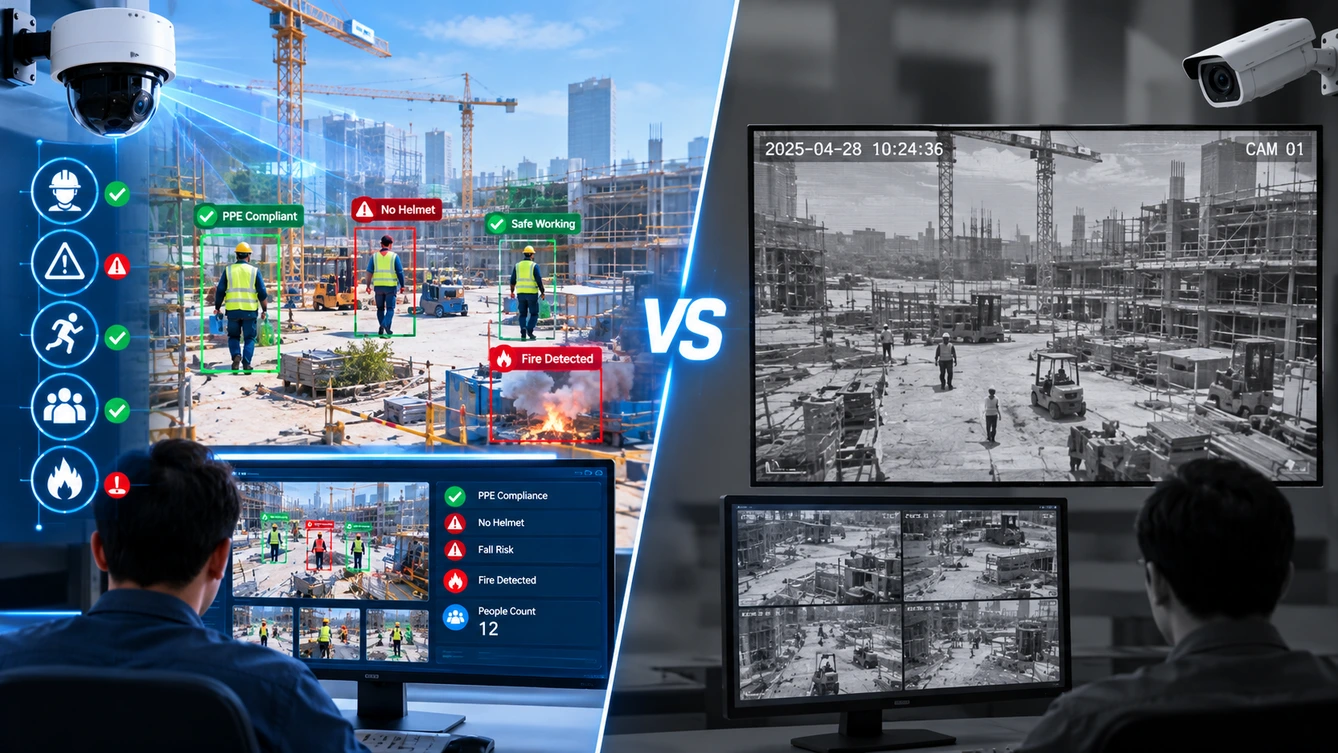
AI vs Traditional Video Surveillance: What Is the Difference?
Video surveillance has long been an important part of security and operational monitoring. Businesses use CCTV cameras to monitor offices, warehouses, construction sites, factories, parking areas, retail stores, and other facilities. Traditional video surveillance provides businesses with valuable visual records of what happens within a monitored environment. However, conventional CCTV systems generally depend on people to watch camera feeds or review recorded footage when an incident occurs.
AI-powered video surveillance changes this approach. By combining artificial intelligence, computer vision, and video analytics, modern surveillance systems can analyse video automatically, identify specific objects or events, and generate alerts when predefined conditions occur. This creates an important distinction between simply recording what happened and intelligently identifying what is happening.
What Is Traditional Video Surveillance?
Traditional video surveillance typically uses CCTV cameras to capture and record video footage. The cameras may be connected to a Digital Video Recorder (DVR), Network Video Recorder (NVR), or video management system where footage can be stored and reviewed.
A typical traditional surveillance process looks like:
Camera captures footage → Video is recorded → Operator monitors or reviews footage → Incident is identified → Action is taken
The system provides visibility, but much of the interpretation is performed by humans. For example, if a warehouse has 50 cameras, security personnel may need to monitor multiple screens or search through recorded footage after an incident has occurred. This can become challenging as the number of cameras and the amount of video data increases.
What Is AI-Powered Video Surveillance?
AI-powered video surveillance combines cameras with computer vision and artificial intelligence. Instead of simply recording video, AI can analyse the visual information captured by cameras. Depending on how the system is designed and trained, AI can detect objects, movement, behaviours, and predefined events.
Examples include:
• People entering restricted areas
• Missing personal protective equipment (PPE)
• Vehicles entering prohibited zones
• Worker and vehicle proximity
• Unusual movement
• Crowd formation
• Objects left in designated areas
• Safety-zone violations
• Vehicle activity
When a predefined event is detected, the system can generate an alert for a security or operations team.
The process becomes:
Camera captures footage → AI analyses footage → Event detected → Alert generated → Human responds
This allows surveillance systems to become more proactive.
AI vs Traditional Video Surveillance
1. Passive Monitoring vs Intelligent Monitoring
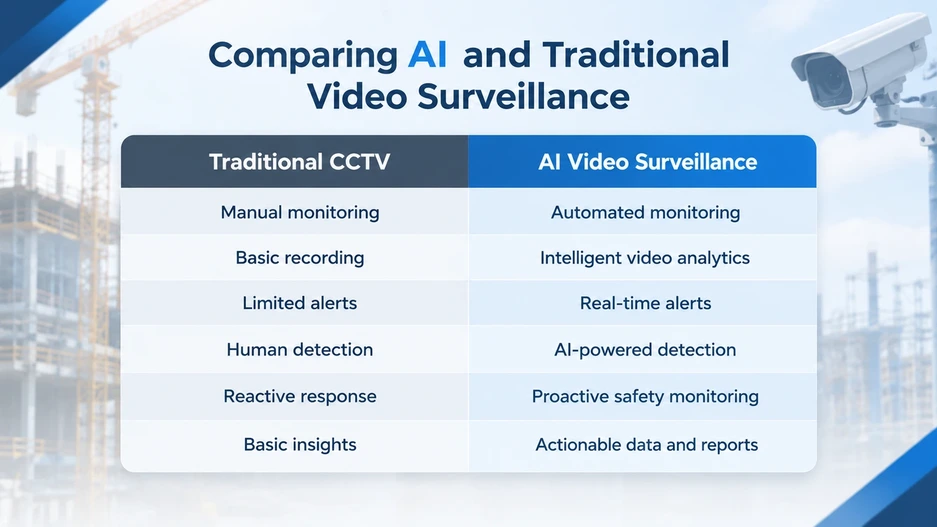
The biggest difference between traditional CCTV and AI surveillance is how the video is processed. Traditional surveillance primarily records video for human observation or later investigation. AI surveillance can actively analyse the video.
For example, a traditional camera may record a person entering a restricted area. An AI-powered system can recognise the person entering the predefined zone and automatically generate an alert. This makes AI surveillance more suitable for environments where real-time event detection is important.
2. Manual Review vs Automated Detection
Traditional surveillance often requires employees to review footage manually. If an incident occurred at 3:00 PM, a security officer may need to search through hours of footage to find the relevant event. AI can reduce this workload by automatically identifying specific events.
Instead of reviewing an entire recording, operators can receive alerts or search for particular types of events. This can significantly improve the efficiency of video monitoring.
3. Reactive Security vs Proactive Monitoring
Traditional surveillance is often reactive. An incident occurs, and the organisation reviews the footage to determine what happened. AI can introduce a more proactive approach.
For example, if a person enters a restricted zone, an AI system can identify the event immediately. The organisation can then respond before the situation develops into a larger security or safety issue. This distinction is particularly valuable in construction sites, warehouses, manufacturing facilities, and other environments where hazards can develop quickly.
4. Human Attention vs Continuous AI Analysis
Human monitoring has natural limitations. Security personnel can become tired, distracted, or overwhelmed when monitoring multiple camera feeds for long periods.
AI systems can continuously analyse video feeds according to predefined rules. This does not mean that AI replaces security personnel.
Instead, AI can act as an additional monitoring layer that identifies events and directs human attention toward areas requiring investigation. This allows security teams to focus their time on situations where human judgement is required.
5. Basic Recording vs Actionable Insights
Traditional CCTV primarily provides video evidence. AI-powered systems can turn video footage into structured information.
For example, an AI analytics platform could generate data showing:
• Number of people entering an area
• Number of safety violations
• Number of restricted-zone events
• Vehicle movements
• Frequency of specific incidents
• Events by time or location
This information can be displayed through dashboards and reports. Businesses can use these insights to identify recurring patterns and improve their security or operational processes.
AI Video Surveillance for Workplace Safety
AI surveillance has applications beyond security. Businesses can use computer vision to improve workplace safety.
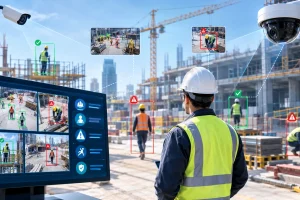
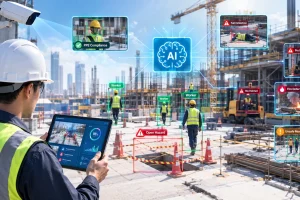
For example, AI can detect whether workers are wearing required PPE. A construction site may require helmets and high-visibility vests. An AI-powered camera can monitor designated areas and identify potential PPE violations. Similarly, AI can monitor interactions between workers and heavy machinery.
If a pedestrian enters a predefined vehicle operating zone, the system can generate an alert. This can help businesses identify unsafe conditions before they result in an accident.
AI Video Surveillance for Warehouses
Warehouses are another environment where AI-powered surveillance can provide significant operational value.
Warehouses often contain workers, forklifts, trucks, inventory, loading areas, and restricted zones.
AI can monitor these environments for predefined events.
Potential applications include:
• Forklift and pedestrian monitoring
• Restricted-zone detection
• PPE compliance
• Loading-area monitoring
• Vehicle movement
• Inventory-related visual monitoring
• Safety violations
Instead of requiring employees to monitor every camera continuously, AI can highlight events that require attention.
AI Video Surveillance for Construction Sites
Construction sites are constantly changing.
New structures, equipment, workers, vehicles, and work zones can create new safety challenges throughout a project.
AI-powered cameras can provide continuous monitoring of designated areas.
Potential applications include:
• PPE detection
• Restricted-area monitoring
• Worker-equipment proximity
• Vehicle-zone monitoring
• Site access monitoring
• Safety compliance
• Hazard detection
This can provide safety teams with additional visibility across large or difficult-to-monitor areas.
Comparing AI and Traditional Video Surveillance
Does AI Replace Traditional CCTV?
AI video surveillance does not necessarily replace traditional CCTV. In many cases, AI can be added to existing surveillance infrastructure. Businesses can potentially upgrade selected cameras or integrate AI analytics with existing video management systems. This allows organisations to introduce intelligent monitoring without necessarily replacing their entire surveillance infrastructure. The appropriate approach depends on camera compatibility, network infrastructure, processing requirements, security objectives, and the specific AI capabilities required.
Important Considerations When Implementing AI Surveillance
Businesses should consider several factors before implementing AI-powered video analytics.
Data Privacy
Video surveillance involves sensitive information. Businesses should establish appropriate policies around data collection, storage, access, retention, and usage.
Cybersecurity
Connected cameras and AI systems should be protected against unauthorised access and cyber threats.
Accuracy
AI systems can make mistakes. Businesses should test models under real operating conditions and maintain appropriate human oversight.
System Integration
AI surveillance should ideally integrate with existing security, safety, workforce, or operational systems where appropriate.
Clear Objectives
Businesses should identify specific problems they want AI surveillance to solve rather than implementing AI simply because the technology is available.
The Future of Video Surveillance
The future of surveillance is likely to move increasingly toward intelligent video analytics. Traditional CCTV will continue to provide an important foundation for recording and security, while AI can add another layer of intelligence.
As computer vision technology develops, businesses may be able to analyse increasingly complex activities and connect visual information with data from IoT sensors, access control systems, fleet management platforms, and other operational technologies. This could create a more connected approach to security and workplace management.
Conclusion
The main difference between AI and traditional video surveillance is the ability to analyse video intelligently rather than simply record it. Traditional CCTV remains valuable for monitoring and providing evidence after an event. AI-powered surveillance goes further by analysing video in real time, detecting predefined events, generating alerts, and producing operational insights.
For businesses, the combination of CCTV, computer vision, AI analytics, and human oversight can create a more proactive approach to security and workplace safety.
The goal is not to eliminate human involvement. Instead, AI can help security and operations teams focus their attention where it matters most while providing faster access to meaningful information.
As businesses continue to adopt connected technologies, AI-powered video surveillance is becoming an increasingly important component of modern security, safety, and operational management.