
How AI Is Transforming Construction Site Safety | AI Safety Solutions
September 10, 2026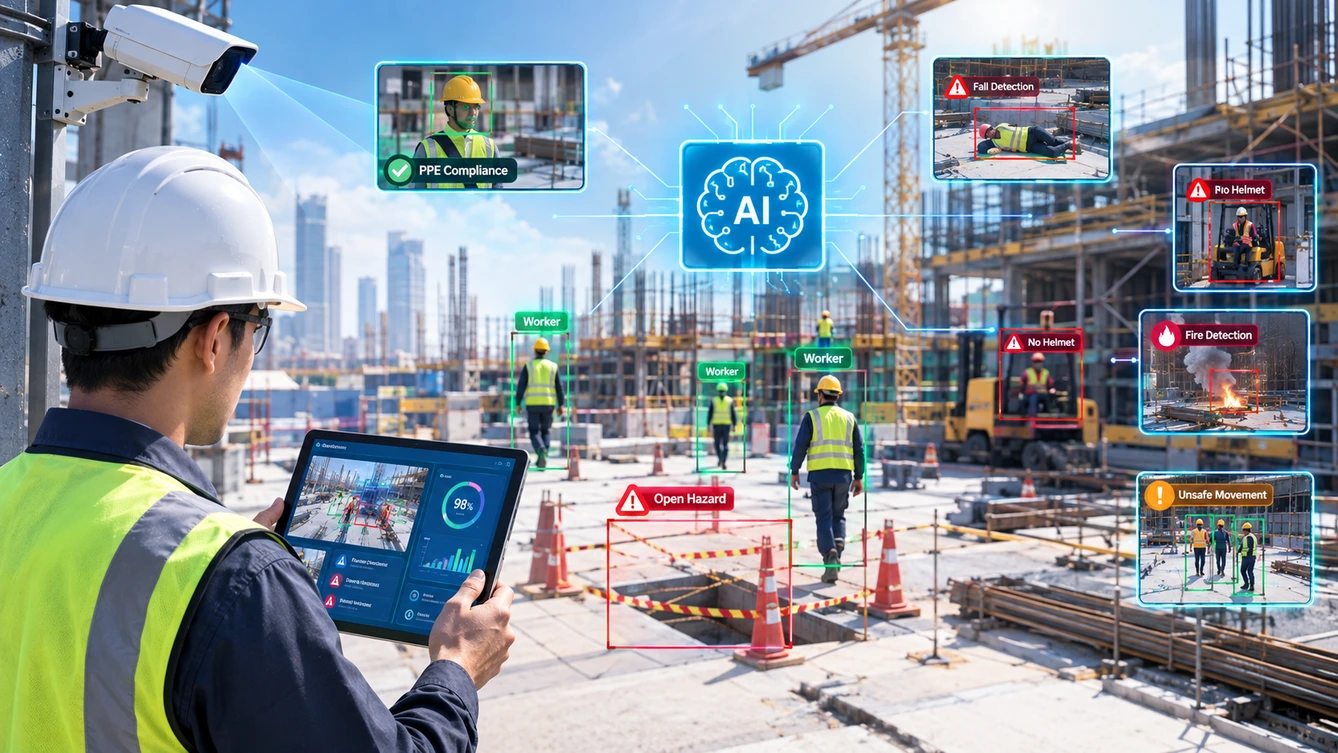
Construction site safety are among the most complex and high-risk working environments. Workers operate around heavy machinery, moving vehicles, elevated structures, hazardous materials, and constantly changing work areas. With multiple activities taking place at the same time, maintaining a safe environment requires continuous monitoring, effective communication, and rapid response to potential hazards.
Traditional construction safety practices rely on inspections, toolbox meetings, safety officers, CCTV monitoring, and worker training. While these methods remain essential, Artificial Intelligence (AI) is providing construction companies with new ways to identify hazards and improve safety management.
From AI-powered cameras and computer vision to predictive analytics and connected IoT devices, AI can help construction companies detect risks earlier, monitor compliance, and make better safety decisions.
What Is AI in Construction Site Safety?
AI in construction safety refers to the use of artificial intelligence technologies to monitor, analyse, and predict potential safety risks on construction sites.
AI systems can process large amounts of information from cameras, sensors, equipment, and operational systems. Instead of relying entirely on manual observation, these systems can continuously analyse activities and identify conditions that may require attention.
Some common AI applications include:
• PPE detection
• Worker and vehicle monitoring
• Restricted-zone detection
• Fall-risk monitoring
• Unsafe behaviour detection
• Equipment monitoring
• Hazard identification
• Real-time safety alerts
By combining these capabilities, AI can provide construction companies with an additional layer of safety monitoring.
AI-Powered Computer Vision for Construction Sites
One of the most significant applications of AI in construction safety is computer vision. AI-powered cameras can analyse live video feeds and recognise objects, people, vehicles, and activities. Unlike traditional CCTV, which mainly records footage for later review, computer vision can automatically identify predefined safety events. For example, an AI camera may recognise when a worker enters a restricted area or when a pedestrian gets too close to heavy machinery. The system can then generate an alert for supervisors to investigate the situation. This can be particularly useful on large construction sites where safety personnel cannot physically observe every area at all times.
Automated PPE Detection
Personal protective equipment is a fundamental component of construction site safety. Depending on the task, workers may need to wear helmets, safety vests, gloves, protective eyewear, safety footwear, or other equipment. Manual PPE inspections can be time-consuming, particularly when hundreds of workers are entering or moving around a site. AI computer vision can automatically check whether workers are wearing required protective equipment. If the system detects a worker without the required PPE, it can trigger an alert. This allows safety teams to respond more quickly and helps reinforce PPE compliance throughout the site.
Monitoring Workers and Heavy Machinery
Construction sites often contain excavators, cranes, trucks, forklifts, loaders, and other heavy equipment. The interaction between workers and moving machinery can create significant safety risks. AI can analyse the positions and movement of workers and equipment to identify potentially dangerous situations. For example, if a worker enters an equipment operating zone, the system can detect the event and notify the relevant personnel. This type of monitoring can provide an additional safety barrier in areas where visibility is restricted or where machinery operators may have blind spots.
Detecting Restricted-Zone Violations
Construction sites frequently contain hazardous areas that require controlled access.
Examples include:
• Excavation zones
• Crane operating areas
• Electrical work areas
• Material storage zones
• Demolition areas
• Heavy equipment zones
• Areas under construction
AI-powered video analytics can establish virtual boundaries around these areas.
When a person enters a designated restricted zone, the system can automatically identify the event and generate an alert.
This allows supervisors to respond before the situation develops into a more serious incident.
Improving Fall Prevention
Falls from heights are a major concern in construction. Workers may operate on scaffolding, rooftops, ladders, platforms, and elevated structures. Identifying unsafe positioning manually can be challenging, especially across a large site. AI-powered systems can be used to monitor designated high-risk areas and identify activities or movements that may indicate a safety concern.
When combined with appropriate site controls, barriers, harness requirements, access systems, and worker training, AI monitoring can provide an additional layer of protection. AI should not replace physical fall-prevention systems, but it can help safety teams identify situations that deserve immediate attention.
Real-Time Safety Alerts
Speed is extremely important when dealing with workplace hazards. A traditional safety inspection may identify a problem during a scheduled inspection, but the situation could change before the next inspection takes place. AI-powered monitoring can operate continuously.
A typical process may look like:
AI camera detects hazard → System analyses event → Safety violation confirmed → Alert generated → Supervisor responds
This can help reduce the time between hazard detection and intervention.
Alerts can potentially be delivered through dashboards, computers, mobile devices, or integrated workplace management systems, depending on the technology being used.
Reducing the Burden on Safety Teams
AI is not intended to replace construction safety professionals. Instead, it can help them manage large and complex environments more efficiently. Safety officers can spend less time manually reviewing hours of CCTV footage and more time responding to important incidents, conducting inspections, training workers, and improving safety procedures. AI essentially acts as an additional monitoring tool that helps bring potentially important events to the attention of human experts.
Building a More Proactive Safety Culture
Perhaps the biggest benefit of AI is its ability to support a shift from reactive to proactive safety management. Traditional safety management often focuses on investigating incidents after they occur. AI can help organisations identify unsafe conditions before they result in an accident. For construction companies, this means safety data can become part of everyday decision-making rather than simply being used after an incident. By monitoring trends, identifying recurring violations, and improving site processes, businesses can continuously improve their safety practices.
The Future of AI in Construction Safety
In Singapore, the Ministry of Manpower (MOM) mandates the use of Video Surveillance Systems (VSS) for construction worksites, which heavily leverages Video Analytics (VA) / AI to automatically monitor and detect Personal Protective Equipment (PPE) compliance and other high-risk behaviors.
As AI technology continues to develop, construction safety systems are likely to become increasingly intelligent. Future solutions may combine computer vision, IoT sensors, predictive analytics, drones, digital twins, equipment telematics, and connected workforce systems.
The result could be a construction environment where safety information is collected continuously and analysed in real time.
However, technology should complement—not replace—fundamental safety practices. Proper training, risk assessments, personal protective equipment, site inspections, engineering controls, and clear safety procedures will continue to be essential.
Conclusion
AI is transforming construction site safety by giving companies new tools to identify hazards, monitor compliance, and respond to risks more efficiently.
Through computer vision, AI can detect PPE violations, monitor worker-equipment interactions, identify restricted-zone access, and provide real-time safety alerts. Predictive analytics can also help businesses identify recurring safety patterns and take preventive action.
When combined with IoT sensors and connected workplace systems, AI can provide construction companies with a more comprehensive view of site safety.
The future of construction safety is not about replacing people with technology. It is about giving safety teams better information, faster alerts, and smarter tools to prevent accidents before they happen.